
Accelerated Erosion – exposing ancient clay is a beautiful, innovative exhibit about clay and erosion at the Craig Gallery, Alderney Landing, Dartmouth, to May 26.
The medium is the message as Seaforth artists Iris Naessens-Patterson and Marlene York experiment with locally-found red clay for a variety of artworks from carved landscape plaques to York’s series of paintings using clay as paint.
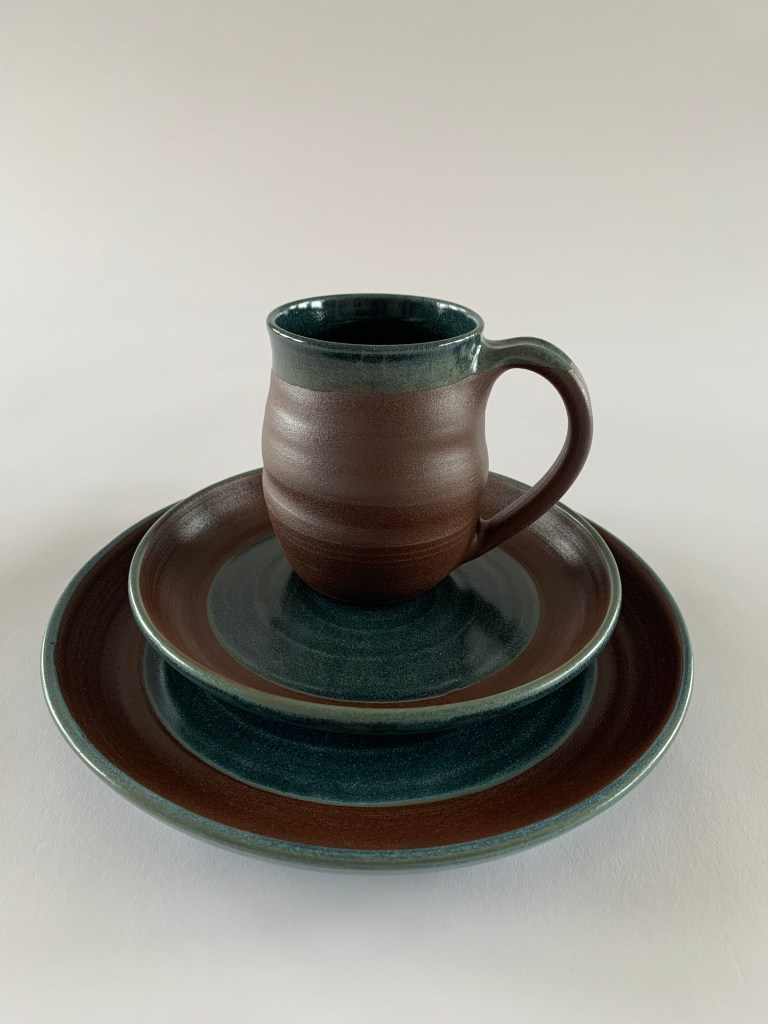
(Pottery enthusiasts take note; Naessens-Patterson’s functional dishes and vessels (at affordable prices) are gorgeous in reddish brown clay with a smoky blue interior glaze – earth and water co-existing in one dish.)
However, this show is larger than that. Working solo and as a duo, the artists run imaginatively with their concept for a rich variety of work responding powerfully and intelligently to subject and place.
Much of the clay and inspiration come from close to home. Nassens-Patterson, a potter, and York, a painter and multi-media artist and teacher, have hiked into the headland at Graham Head in Three Fathom Harbour to cut clay out of the cliffs – one painting by York shows her doing exactly that – and carry it home in their backpacks.


granite and lcoal clay slip,
Iris Naessens-Patterson. (courtesy of
the artist)
“By using these clays in our artworks we hope to bring attention to the concern of accelerated erosion caused by climate change, especially as it affects the coast where we both live,” they say in an exhibit statement.
While the show points to the effects of climate change, it is also a celebration of the beauty of eroding cliffs, scrubby pines, rocky shores and the ocean. York paints in clays from each of the places she is painting so Scott’s Bay near Cape Split is a vista of sea and sky painted in the rocky beach’s unusual grey clay.
At the Graham Head beach they saw large pieces of concrete and rebar that a landowner once set at the base of cliffs to stop erosion. Naessens-Patterson tops two of her tall, elegant vases with a piece of kinetic rebar as a handle on the lid.
Together they created stoneware vessels, made by Naessens-Pattersons with layers of burnished slip, and carved by York in imagery from Graham Head. There is something magical and mystical in the contrast between the earthiness and sense of permanence in the clay and the delicacy of the white line. These works feel as old as Grecian urns and chalk paintings in caves.
As a painter York experimented in her use of clay as a painting medium on canvas, both raw and gessoed, and on board. “I began with raw clay mixed with some water in a bucket and painting with it on raw canvas.”
Concerned about durability, she tried other media. She dried the clay, ground it up and sieved it, mixing it with an acrylic medium. She also used egg yolk, inspired by egg tempera painting.
York’s paintings with clay are pale and ethereal – almost windswept – interpretations of land and sea in various Nova Scotia locations using clay from the location she is painting. These include Gaetz Head, Diligent River and Shubie Beach Park as well as Great Codroy, Nfld., and Ban Chan Lua, Laos.
The Laos painting is a reminder that rising sea level and coastal erosion are a global problem and certainly top-of-mind in Nova Scotia where protest against the province abandoning the Coastal Protection Act is ongoing.
Erosion is revealing more and more clay deposits which were formed as glaciers retreated leaving rock, soil and clay in eskers, moraines, drumlins and other land forms. “A beautiful red clay-loam can be found throughout Nova Scotia,” say the artists. “This Pleistocene clay is one of the layers found in drumlins.”
The two live in the Chezzetcook Drumlin Field encompassing Lawrencetown, Three Fathom Harbour and Seaforth.
This exhibit is beautifully clear and includes a map showing where the clay deposits are and a shelf of tiny vials of clay from different locations.
‘Accelerated erosion’ is an imaginative departure for the artists whose other work can be seen on their websites: for Naessens-Patterson go to seastarpottery.com and for York www.seaforthstudio.com
The show is on to May 26 followed by Colourful Community Connections, the annual group show by the Dartmouth Visual Arts Society, May 28 to June 30 with an opening May 30, 6 to 8 p.m.
The Craig Gallery, Alderney Landing, is open Tuesday to Friday, 10 to 5; Saturday 9 to 1 on market day; Sunday 11 to 3; closed Monday.


- Leaving Home: a must-see, reboot of a Canadian classic with a crackerjack team
- Dance Nation is Wild!
Categories: Uncategorized
Tags: Art, blog-tour, potter, pottery, travel
 NS reviews
Congratulations to both artists. Great concept, amazing work. Love the concept.
LikeLike
This is brilliant and unique artwork that needs to be experienced up close to fully appreciate.
LikeLike
Absolutely brilliant – thank you for writing about this show – important in so many ways.
LikeLike