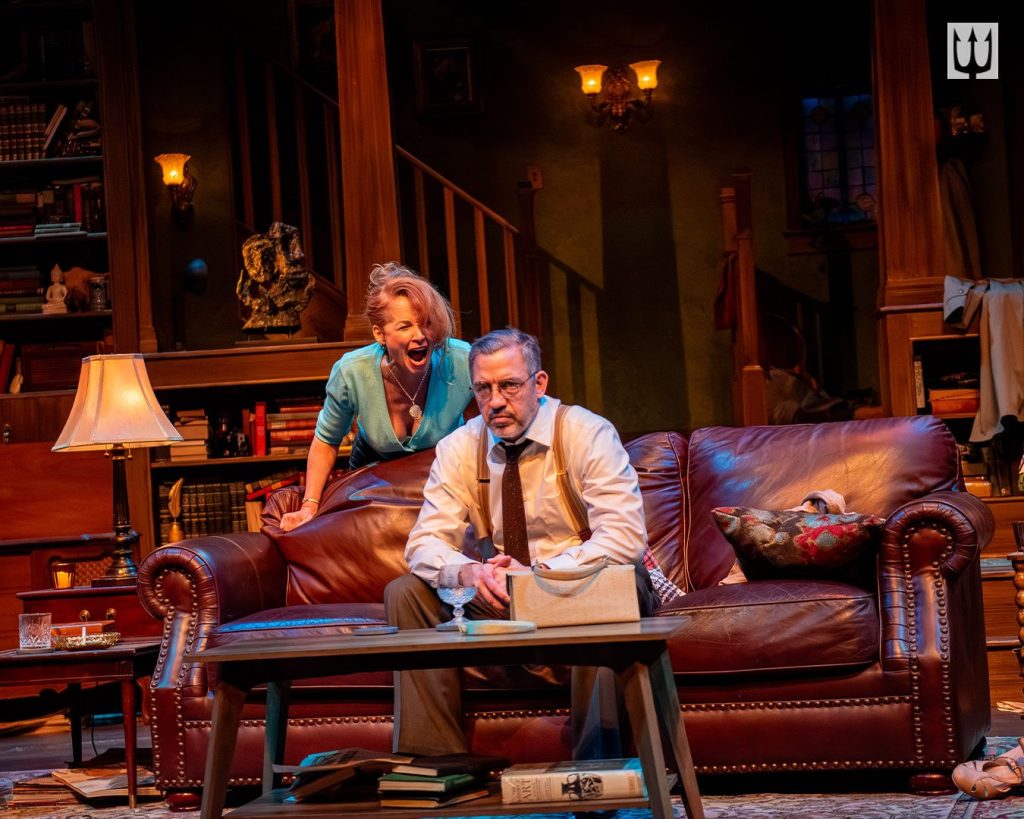
Edward Albee’s 1962 hit, Who’s Afraid of Virginia Woolf?, glitters in all of its comedy and savagery in a riveting production at Neptune Theatre just to March 15.
Albee’s suspenseful psychological drama about a devastated marriage — and so much more — is a cat-and-mouse game between two couples who take the gloves off as soon as they connect on a night of alcohol, revelations and personal attacks.
It shocked people in the 1960s. It is still shocking, as well as relevant and theatrically exhilarating, with Albee’s playful, searing language, his themes of love and the American dream, and his demands on his actors. Ann-Marie Kerr, a Siminovitch Prize finalist for theatre direction, directs fearlessly and flawlessly with a superb cast of Nova Scotians: Anthony Black, Raquel Duffy, Patrick Jeffrey and Kya Mosey.
George and Martha are already sniping at one another after a faculty party when Nick, a new biology professor, and his wife Honey arrive for more drinks. Over three acts the older couple spar and brawl, revealing the illusions and games propping up their lives, all the while mixing drinks in their cozy, book-filled New England home.
Raquel Duffy’s performance as Martha is in the stratosphere. IShe gives this acidic monster of a woman all her sizzling, magnetic energy — wit, sexuality, anger — while still crafting her despair. The scene at the beginning of Act Three, when a fragile Martha stands on a table to see if she can spot George out the window, is unforgettable.
George’s venom is initially hard to understand until one sees the depth of his emasculation — the erudite history professor who never became department head, now threatened by Nick’s ambition, field of science and good looks. Anthony Black has the look and demeanour of the “bog” Martha calls him, yet he is as wonderfully animated and feral as she is in their fighting. His ability to handle all the halts, trips and switches in Albee’s language is spellbinding, as is his balancing act of George’s deep despair and his aggression. (Black is Kerr’s husband, so one can only imagine the conversations they’ve had about this play.)
The actors playing the young couple can often get cast aside by the flaming mess of George and Martha, but here they are powerful, equal players. Patrick Jeffrey is totally present as the well-built, ambitious Nick; Kya Mosey’s Honey is at first comically out-of-tune with the evening’s chaos but then irresistible as she grows in strength, volume and expression of pain. Watch how her hair devolves.
Two dances are at the heart of this production: Honey’s whimsical interpretive solo (like Wednesday Addams in the TV series Wednesday) and Martha and Nick’s highly sexualized modern mating dance, performed as if they were two malignant peacocks.
While not a lighting-intensive show of changing colour, Jess Lewis’s design is key to establishing time and mood. Tamara Marie Kucheran’s wonderfully detailed set features lamps that glow in the darkness act like lighthouse beams. The use of light to make the set appear scrambled and destroyed at play’s end is effective on its own — the wooden slats dropping from the ceiling feel like unnecessary exclamation points. The first two acts end with light on George’s face; the last with light on Martha’s. It’s shattering.
Duffy’s deflation of this fierce, remarkable woman is aided by Sean Mulcahy’s costume design. Martha moves from party dress to a stretchy, sexy top and pants, and finally into ill-defined casual clothing that seems to be in her way. Her hair, too, devolves.
Since the play is about the illusions people create to survive, the audience is always questioning what is real and what is not. As Nick slowly begins to understand what George is doing to Martha and says “I understand,” a woman near me in the audience said aloud, “I don’t!” — just before the ultimate secret was revealed.
The play runs three hours with two intermissions, but it is entirely worth it. It belongs among the great, weighty American classics about tormented people locked in twisted, co-dependent marriages. Martha easily recalls the epic, damaged women of Tennessee Williams and Eugene O’Neill; George is an academic version of the tragic failed man — a Willy Loman.
Kerr’s own description of the play in the press release is apt: “At its core, this play reveals a world that doesn’t keep its promises. A brutal, broken mirror is held up to America in the 1960s, exposing the illusions beneath these lives. The shock of that exposure feels violent. It’s quite a ride, and ultimately a great love story.”
Tickets are on sale now by contacting the box office at (902) 429-7070 or by visiting http://www.neptunetheatre.com today.
Categories: Uncategorized
Tags: drama, edward-albee, reviews, theatre
 NS reviews
What a great review!!
I don’t know whether I will go out of curiosity or out of that thing where you can’t take your eyes off a disaster!
xoP
Pam Cooley
Choosethical Ventures Inc. https://ca.linkedin.com/in/pamcooley
902.403.8407 cell
>
LikeLiked by 1 person
My friend and I really enjoyed the performance. I did wonder why the two beams descended at the end, when the main characters seem to have finally come to peace with themselves and each other.
LikeLiked by 1 person