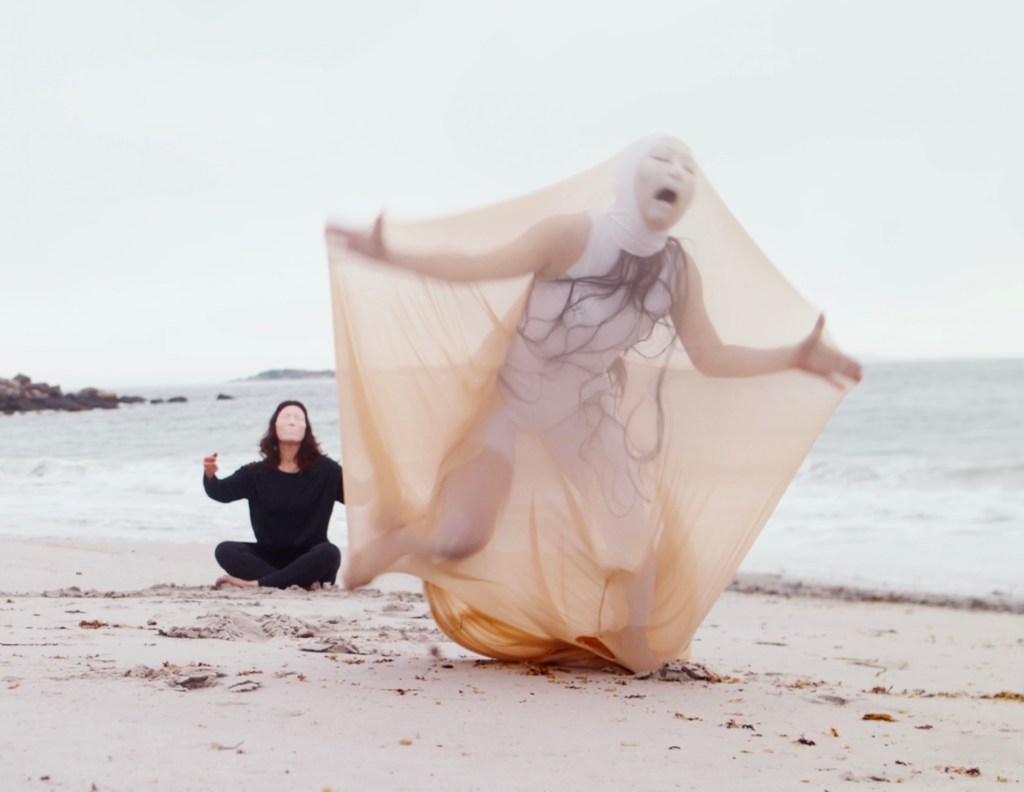
The living and the dead come together in a mesmerizing Butoh dance exploring legacy, identity and Japanese Canadian history.
Ladder 梯子 at the Bus Stop Theatre, Halifax, June 28, 7:30 p.m., and June 29, 2 and 7:30 p.m., is a collaboration between Halifax artist and mask maker Miya Turnbull and Butoh dancer and choreographer Emiko Agatsuma. (tickets at: https://bit.ly/laddertickets)
The two first connected on Instagram during the pandemic and bring their very different body types, histories and art forms together in Ladder 梯子.
Turnbull is tall, raised outside Edmonton on a farm and a fourth-generation Japanese-Canadian; Agatsuma is petite, lives in Tokyo and is an expert on Butoh dance with its low-to-the ground, bent movement and facial expressions of elevated emotion. Until she met Turnbull, she was completely unaware of the internment of Japanese-Canadians and the confiscation of their property during the Second World War.
Together they have created Ladder 梯子, a fascinating and intense 40-minute fusion of Butoh dance and numerous self-portrait masks with original music composed and performed on stage by Edmonton musician Gozu Mezu (Hitoshi Sugiyama).
The piece, seen during a rehearsal performance, is a poetic and powerful exploration of birth and death; sorrow, anger and joy; ancestors, legacy and identity. Turnbull, always masked, becomes an old Japanese woman who slowly bends and sways; her back is to us but the mask on the back of her head is a frontal view of a woman’s face which makes for a compelling distortion. (The figure is both backwards and forwards in time and space.)
Agatsuma is close to the floor bending, twisting, pushing out at a nylon stocking cage like a womb that encases her. Later, free of it, she gets twisted up in a tangle of masks tied together in stretchy nylon.
It is up to the audience to make its own story, say the artists, but Turnbull’s family history of immigration and internment informed Agatsuma’s choreography. “I imagined I was there,” says Agatsuma, who was shocked by this history and handed out a questionnaire to Japanese-Canadians to find out more.
“Some people gave me their private memories. Some said they felt racism and discrimination and some remember the hard time of forced labour. This inspired me.”
Turnbull’s great-grandfather left Japan to sail to Victoria, B.C., in the early 1900s. During the Second World War the family moved to southern Alberta. “The only way they could stay together was if they worked on sugar beet farms,” says Turnbull. “That’s where my mum grew up. A lot of our culture got disconnected. A lot of us are searching to connect.
“A lot of my mum’s generation married white Canadian men. A lot of my generation is half; our kids are one quarter but the Japanese-Canadian community is very accepting of this. There has been a pull to connect us all and to try to redefine ourselves and, even with the kids who are blond with blue eyes and don’t speak Japanese, the community has been so welcoming.”
After the war Turnbull’s family moved to Lethbridge, which has a large Japanese-Canadian community; however, her mother left that community behind to move to Edmonton. Her mother, who died recently, insisted that the family history be recorded in a book. “It was so important to my mum,” says Turnbull, “because no one talked about it. One of my masks has no mouth.”
Each of Turnbull’s masks, of papier-mâché and manipulated photographs with facial imagery both inside and outside the mask, is a self-portrait, she says.
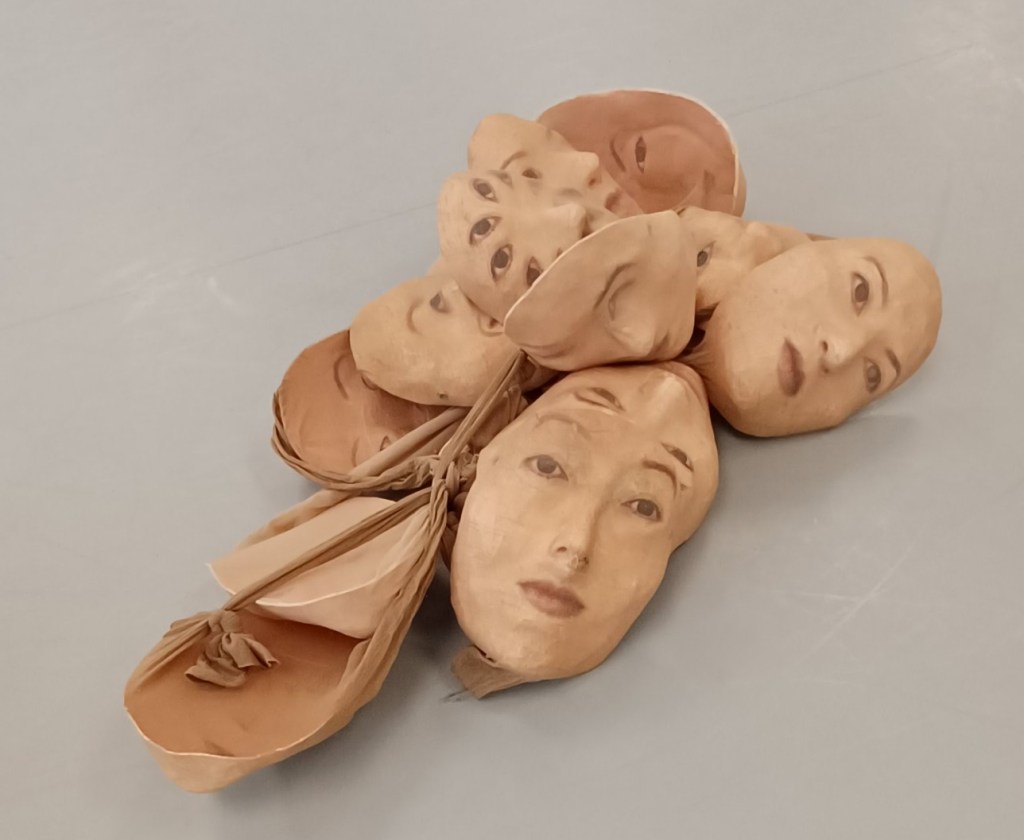
Two in the show are inspired by Agatsuma and several by the heightened emotions in Butoh dance which Turnbull studied online with Agatsuma, who is art director at AGAXART (https://www.agaxart.com).
“I was looking at Butoh for movement ideas. The way Emiko teaches is going deep within and connecting to the subconscious. We felt such a strong connection.”
Butoh Dance
Butoh is a Japanese interpretative dance born in the 1960s as a post-war, avant-garde movement in a reaction against Western styles of dance.
“Our bodies are very short and small compared to Western dancers and Japanese dancers felt inferior,” says Agatsuma. As well, after the devastation of the Second World War, the Japanese had lost confidence in their culture and belief systems.
Looking to invent a new vernacular dance, artists looked to countryside harvest festival dances. “Most people believe that farmers’ bent backs are unfashionable but Japanese dancers thought it was a beautiful posture. Butoh dance poses the question, ‘What is beauty?’”
The movement starts from the position of the body being an empty form, not a unique individual. It is often focussed on the negative, says Agatsuma. “We use anger or grief or pessimism and strong emotion. It looks very angry. Sometimes we use the posture of sickness, it looks a little miserable but Butoh dancers think it is truly beautiful.
“Mostly Japanese don’t show emotion clearly,” says Agatsuma. “We are good at hiding emotion.”
As well as hidden emotions Japanese culture also has a lot of monsters. “We’ve added the motif of the Japanese monster, Yo-kai.”
“Butoh is close to very dead people’s world. Alive people need to focus on identity, who am I? But with dead people it is the opposite. They are like nobody.”
Agatsuma says her choreography is always in between a dead and a living people’s world. “Miya is alive and trying to search for her identity but I am a Butoh dancer and I see the world from the viewpoint of the dead people’s world. Our creation stories are in opposition but we try to find something new together.”
They are both excited by their collaboration. “We really want to expand and develop it,” says Turnbull. “We want to perform more in Canada and Emiko wants me to come to Japan. It’s been a wonderful experience.”

Categories: Uncategorized
 NS reviews