Soil Body: Art Meets Science, co-curated by Doug Pope and Sue LeBlanc and a Robert Pope Foundation project, asks this question: “Is there a connection between human health and the environment?”
The answer isn’t as simple as you might think in art by 11 Nova Scotian artists and one Japanese artist responding to this question in a wide range of expression, thought and media.
Artists talk about the human body, nature and society as complex, interconnected systems in this interesting and educational show – three years in the making – at the Ross Farm Museum to June 30.
Works range in mood from Kate Church’s fanciful and exquisitely-rendered Sleeping Gnome, of a barefoot figure asleep on a bed of hand-stitched blankets, to Curtis Botham’s grim, charcoal landscape drawing of a Stellarton coal mine, displayed as a digital print. Coal mining is a system of resource extraction that people have long depended upon for heat and employment; yet, it has destroyed miners’ health, people’s lives and the Earth.
Much of the work is appealing – bright, unusual and innovative – but there are deeper examinations should you wish to make them. Alex Livingston’s digital media artwork Spring Flowers, 2016, of a buoyant, high-colour floral bouquet, is clearly unnatural. It is obvious that the lines and colours are digitally produced in a work that celebrates nature but also points to an artificial and highly technological world far removed from nature.
The film, Yoga Nova, 2023, in which filmmaker Doug Pope records yoga artist Jacqueline Camp posing within nature and as part of nature, is simply beautiful. As the label says, “Rather than disturbing the natural order, the artist demonstrates the lively co-existence of physical being, land and spirit.”
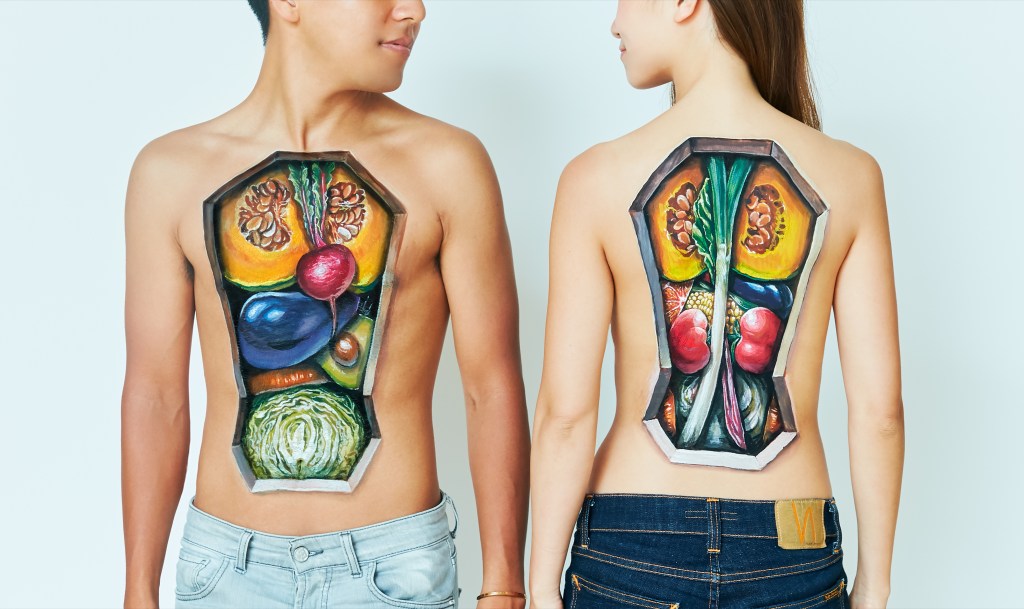
Hiraku Cho opens up the body in a fun and colourful way in We Are What We Eat, 2019, of vegetables that represent organs; an open squash becomes lungs, a leek the esophagus.
Teresa Bergen’s ceramic sculpture, Nursing Mother, 2023, a lively patterned depiction of a mother nursing twins, is about life cycles in general and the need for stewardship (and love) individually and collectively.

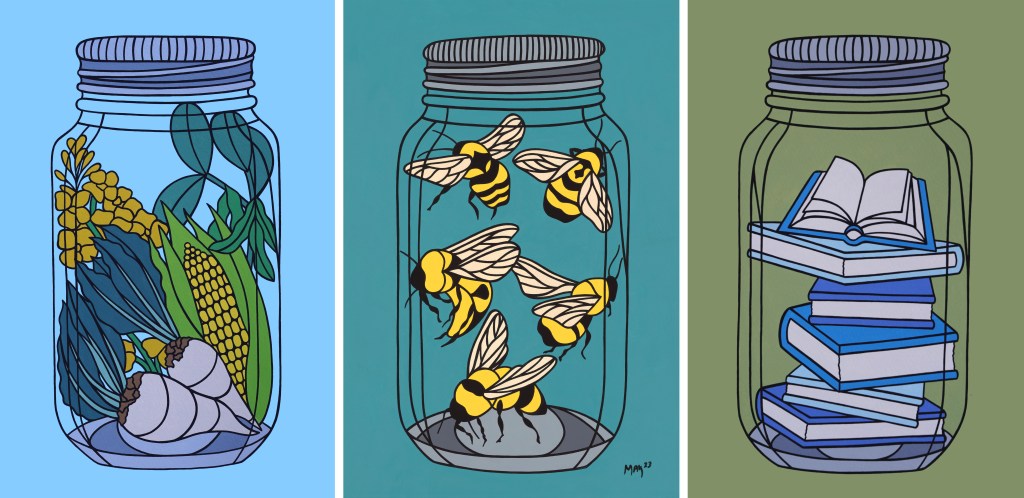
Miyoshi Kondo stresses the value of plant and human life in her playful, graphic series of three jars preserving bees, vegetables and knowledge and in Living Soil, 2023, which is like a child’s storybook illustration of earth teeming with underground life in encircled snails, ants and worms while green shoots send down roots and thrive above.
Elise Campbell’s Morel, 2022, a felt wool fabric sculpture, is a beautiful tactile piece celebrating the patterns within and the roots of the mushroom. She looks at the body’s circulation system in her felt culture Crimson Heart, 2023. Kim Morgan also goes right inside the body with her iron sculpture of a red blood cell.
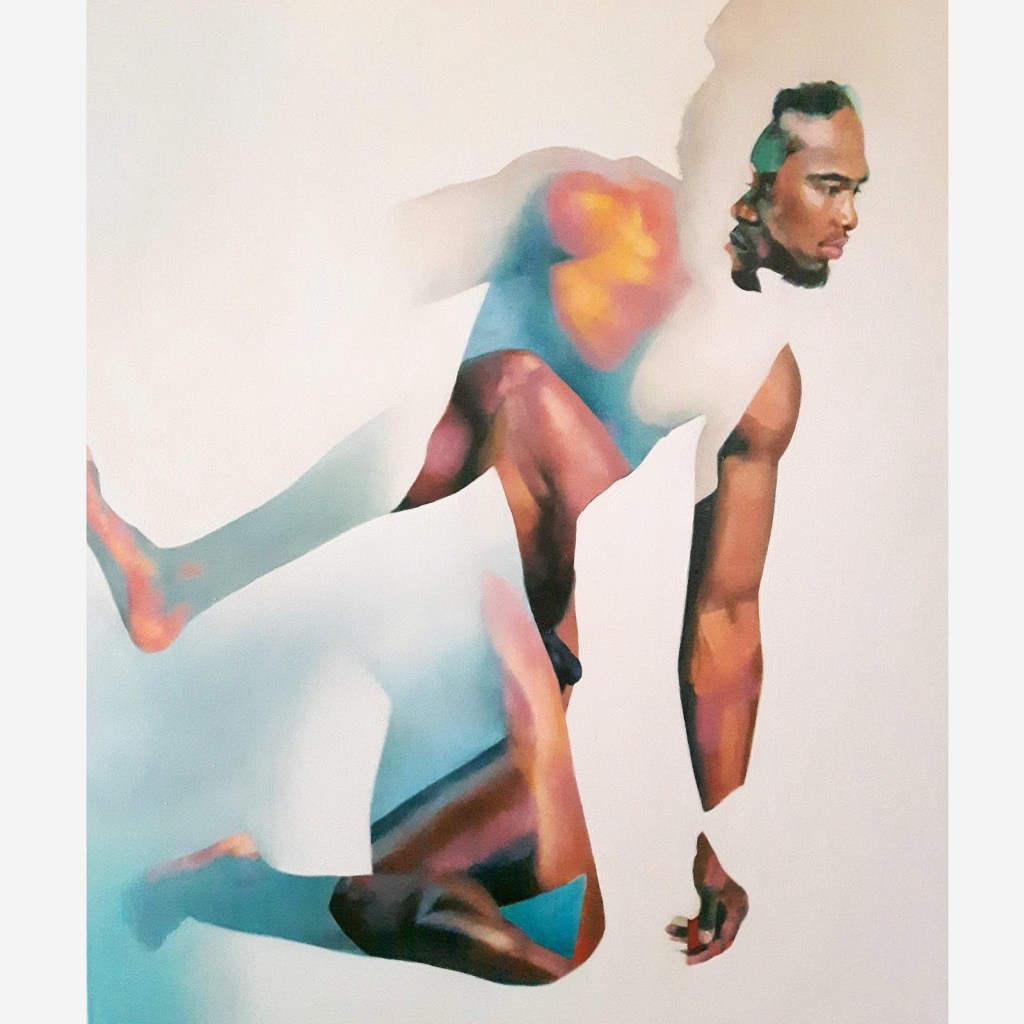
Seemingly far removed from soil but very much about systems and their effect on nature and people is Echo Nara’s works about racism in Rise, 2020, an oil painting exhibited as a digital print. In her art Nara is interested in both the body and botany.
The curators answer the question themselves at the end of their essay: “Returning to the question underlying this exhibition: is it fair to compare our bodies to soil? We see in both a need for the circulation of water, air and raw materials. Both are acted upon by microbes and invisible forces. Both experience growth, need biodiversity for health and foster cooperation on many levels. Both bodies and soil can be looked at through a lens of biology, ecology or culture.”
The curators first put this exhibit together in a smaller form at the Museum of Natural History, Halifax, and there are lots of printed materials to engage with as well as an art table. The museum, itself, is fun to visit with its 60 acres of farmland, animals and buildings that show what life was like on a Nova Scotia family farm in the 1800s. It is both a heritage site and an operating farm dedicated to learning sustainability. This show is dedicated to its late director, Peter Cullen.
The museum is open daily 9.30 to 4.30 but closed on Tuesdays.


- Nipped in the Bud: a powerful journey from darkness to light by Gillian McCulloch
- Mask-maker and Butoh dancer unite for Ladder 梯子, rooted in Japanese-Canadian history
Categories: Uncategorized
Tags: Art, exhibition, exhibitions, ross-farm-museum, soil-body-exhibition
 NS reviews