
Arctic/Amazon: Networks of Global Indigeneity, Art Gallery of Nova Scotia
On the third floor of the Art Gallery of Nova Scotia, at opposite ends, two films blast out in sound and movement.
At one end a Yanomami shaman dances in a storm of orange feathers observed by fellow tribesmen in a Brazilian village; at the other, two Finnish Sámi sisters perform an elegant, contemporary dance that devolves from soprano voices to a pounding rhythm, from traditional to modern dress, from controlled to chaotic movement.
These films bookend Arctic/Amazon: Networks of Global Indigeneity, a two-floor adventure into unknown cultures and idea-based art by highly educated, Indigenous artists concerned about threats of climate change, cultural loss and rampant development to ancient, aboriginal communities.
The challenging, mind-opening, contemporary show, with extensive labels that are very helpful, comes from The Power Plant Contemporary Art Gallery in Toronto in collaboration with the AGNS, where it’s on view to Sept. 11.
The works are often large, striking installations from a giant sled built from carved soapstone to a suite of stunning, high-colour photographs of Brazilian drag performance artist Uýra. They identify as “Indigenous in diaspora” and are costumed as a hybrid plant and animal creature in different masks and face paint. The photographs are rivetting, exotic, frightening and unforgettable. In a video downstairs Uýra burbles up in a former Indigenous Amazonian village now Manaus, where they live and which was first colonized in 1669.
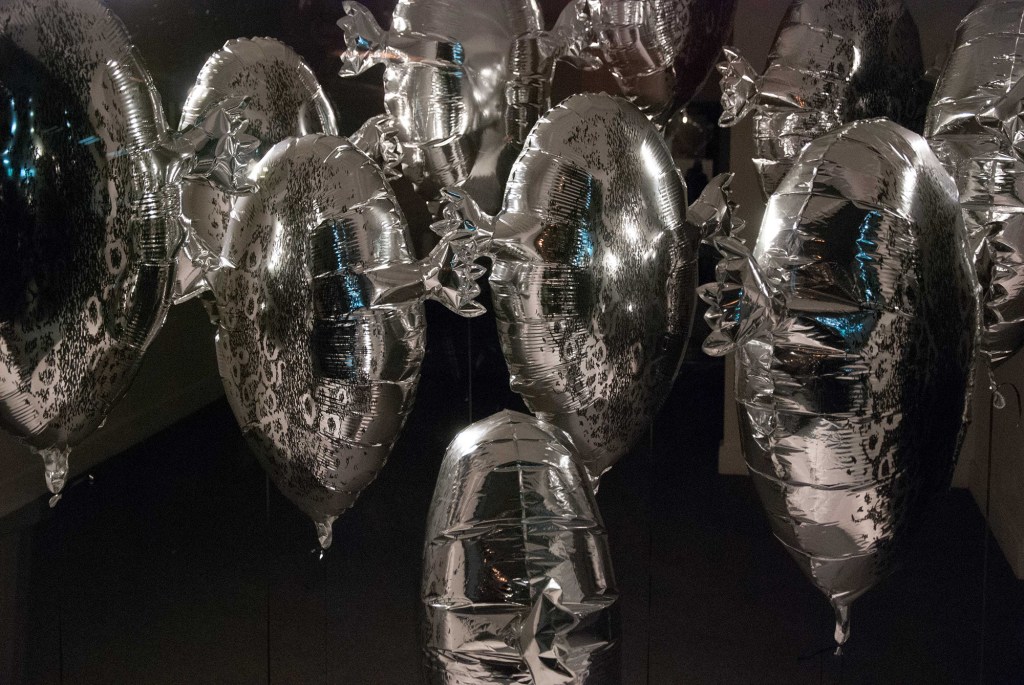
Canadian Inuk sculptor Couzyn van Heuvelen hangs helium-filled mylar balloons shaped and imprinted to represent seals – a traditional resource that has been heavily criticized by the Western world. The seals are meant to look as if they are underwater and it’s quite a magical piece. However, the artist’s use of mylar, a polluting plastic that is choking the world’s oceans and its creatures, is questionable.
The artist, who has a MFA from NSCAD University, also fills a third-floor room with giant fishing lures of plastic, metal and wood, often in eye-popping, jazzy colours. He points to changes in traditional ways of life; lures were meant to be small and carried by this nomadic people much like the small soapstone sculptures for sale in the gallery gift shop.
Máret Ánne Sara, a Sámi artist from Norway, celebrates lassos called southpan used by Sámi reindeer herders in her beautiful video, Gielastuvvan (Snared). Sara’s brother fought the Norwegian government’s order to slaughter his reindeer flock down to 75 reindeer, ostensibly to protect grazing land, but, in reality, to make room for a mine. (To learn a lot about a people I’ve never heard of and their fight to survive as a culture head to Sámi rights – The Museum of Justice (justismuseet.no)
Sonja Kelliher-Combs, an Iñupiaq and Athabascan multidisciplinary artist living in Anchorage, addresses the abuses of the Catholic church in Alaska in the quiet, powerful and emotive installation Idiot Strings.
Pouches stitched from map-printed fabric hang from strings like the strings attached to children’s mittens. According to the label the work “reflects upon the emotional, psychological, and physical burden of carrying painful secrets” but also “references the healing of wounds through the artists’ use of sewing and stitching.” Personally, I find it heartbreaking.
Opposite this piece are dazzling, eye-popping murals in bright colours and pulsating geometric patterns rooted in spirituality by Shipibo-Konibo artists Olinda Reshinjabe Sivano, Wilma Maynas, and Ronin Koshi, of Peru. According to the label, “Shipibo-Konibo mothers put piri piri pepper in the eyes of their daughters so they may visualize kené designs and access ancestral wisdom.”

Curated by Governor General’s Award–winning Indigenous curator and educator Dr. Gerald McMaster —alongside co-curator Dr. Nina Vincent and institutional curator Noor Alé — Arctic/Amazon grew out of the Arctic/Amazon symposium co-hosted by the Ontario College of Art & Design University and The Power Plant in 2019.
The AGNS is open seven days a week, 10 to 5 and to 9 p.m. on Thursdays, with BMO free access night Thursdays from 5 to 9. The gallery holds its annual general meeting June 28, 9:30 a.m., in the Windsor Foundation lecture theatre, and a new CEO is expected to be announced shortly.
I Was Always Here, Argyle Fine Art
Halifax oil painter Annie Murray’s new solo exhibit, I Was Always Here, at Argyle Fine Art, 1559 Barrington St., Halifax, is a fairytale journey into the natural world and the luminosity of the human face.
Murray’s directly references magical tales in her Neverland portrait of a young man with a lit match clamped between his teeth and a monarch butterfly in the foreground. Her Midsummer Dream portrait of a man wearing a crown and medieval furs is full of floating mushrooms and fruit and recalls the fairytale qualities in Shakespeare’s play. However, there could also be a tiny fairy living amongst her more straightforward still life of red and white strawberries against a black background.
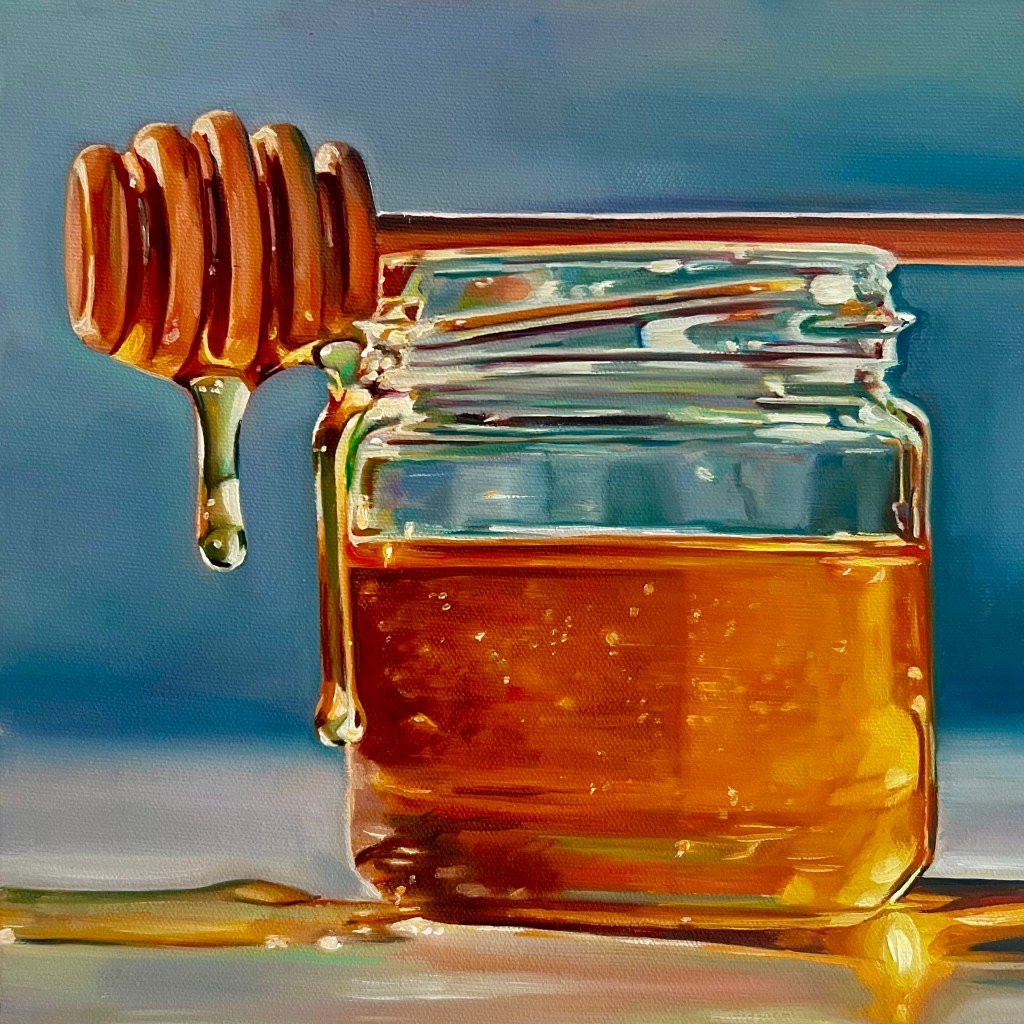
Murray is a precise and flawless realist painter when she wants to be; witness the perfect drop of honey from a wooden dipper in a nod to Mary Pratt. She has a lovely way of combining a polished, air-brushed look with looser, textural elements like the furry fox held by smooth fingers in A Pact We Made. Murray also dramatically uses light and dark adding to the atmosphere of enchantment in many of her images.
The artist also likes to break up her space disrupting realism and adding visual and narrative intrigue. Her portrait of a young woman putting on shoes in a bedroom has a gorgeous semi-abstract side border of hands holding objects in an erasure of blues.
This is Murray’s second show at Argyle and in it she moves purposefully from her earlier bright and playful work into what she calls “a sultrier and more moody aesthetic” and into natural imagery.
Murray grew up on a dairy farm in eastern Ontario and the show’s title refers to her connection to the land. She moved to Nova Scotia in 2018 and started painting during the COVID-19 lockdowns. This new body of work, she says, represents “a collective desire for escapism in a post pandemic world” and nostalgia for a time before technology.
Murray studied studying drawing and painting at OCADU in Toronto but realized she wanted more technical training than a conceptual approach to art. She then studied under Japanese-Canadian painter Keita Morrimoto and was inspired by his use of Dutch Masters and baroque techniques. She is drawn to contemporary painters Jen Mann, Peter Doig and Justin Mortimer.

- Wildlife Recovery Concert this Friday at Scotiabank Centre: tickets $20 to $200
- Rain On The Parade: A Theatrical Satire Like No Other
Categories: Uncategorized
 NS reviews